
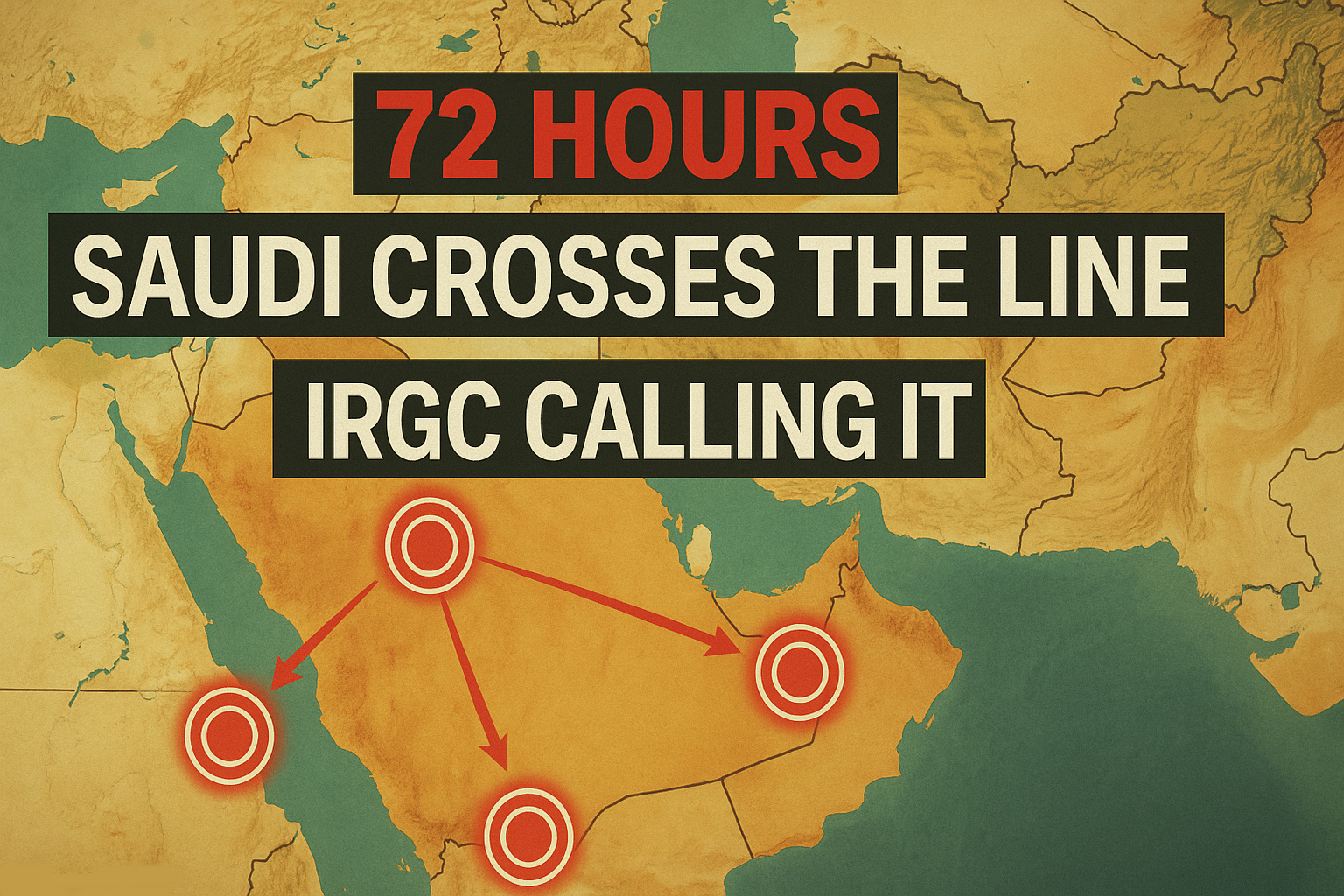
Four days ago I said the squeeze was moving to Yemen and it wasn’t a guess. Overnight, US Central Command and Saudi Arabia ran joint strikes on Iran-backed sites in Iraq. At least twenty dead. And Iran fired ballistic missiles at a US airbase in Jordan, the first Iranian attack since Trump paused combat operations to give diplomacy some room.
That’s not a diplomatic breathing space. That’s the ladder.
Why the Saudis finally moved
Here’s what’s changed in 72 hours. Saudi Arabia has spent five months carefully avoiding direct involvement. They’ve now flown alongside US aircraft. That doesn’t happen on a whim,that happens when you’ve quietly worked out that avoiding the fight isn’t going to keep it away from your oil infrastructure. Iran hit Saudi Arabia with thirty-plus IRGC-directed drone attacks in three days. The Saudis decided their next drone strike was going to arrive with a signature on it.
The IRGC is calling this now. Not the clerics, not the ministry — the Islamic Revolutionary Guard Corps. That’s what David Sanger at the New York Times just said out loud, and if you’ve been reading the tea leaves since 2022 like I have, I mentioned the Azov piece last time,none of this reads as surprising. When you have a hardline paramilitary running the strategy and a US President described by his own party’s intelligence committee members as “confused, lost, somewhat desperate,” the escalation isn’t a policy choice. It’s what happens by default.
Watch what comes next
- Kuwait and Qatar are on the map. The panel discussion I watched already named them. When Iran’s asymmetric play is “we can hit Gulf energy infrastructure,” that’s the target list.
- The Houthis will step up their Red Sea attacks. Bab el-Mandeb was the pressure point I flagged. It hasn’t gone away just because the headlines moved to Iraq.
- Trump’s position is strike, don’t strike, strike hard, pause, wait, sanction , isn’t strategy. It’s improvisation. And improvised policy at this stage of an escalation gives every rogue actor in the region room to write their own story.
The bit the coverage keeps missing
Iran’s problem isn’t military capability, it’s cash. Hyperinflation warnings. Gas shortages in a country that pumps oil. Financial sector on the brink. They want sanctions relief and frozen assets released. Everything else including the missiles, the drones, the Houthi’s, the militias in Iraq, is leverage to get to a payment.
That’s why this widens before it narrows. Iran has to keep the pressure high enough that the sanctions become the cheaper option.
Four days ago this wasn’t a guess. Today it isn’t either.
Leave a Reply
You must be logged in to post a comment.