
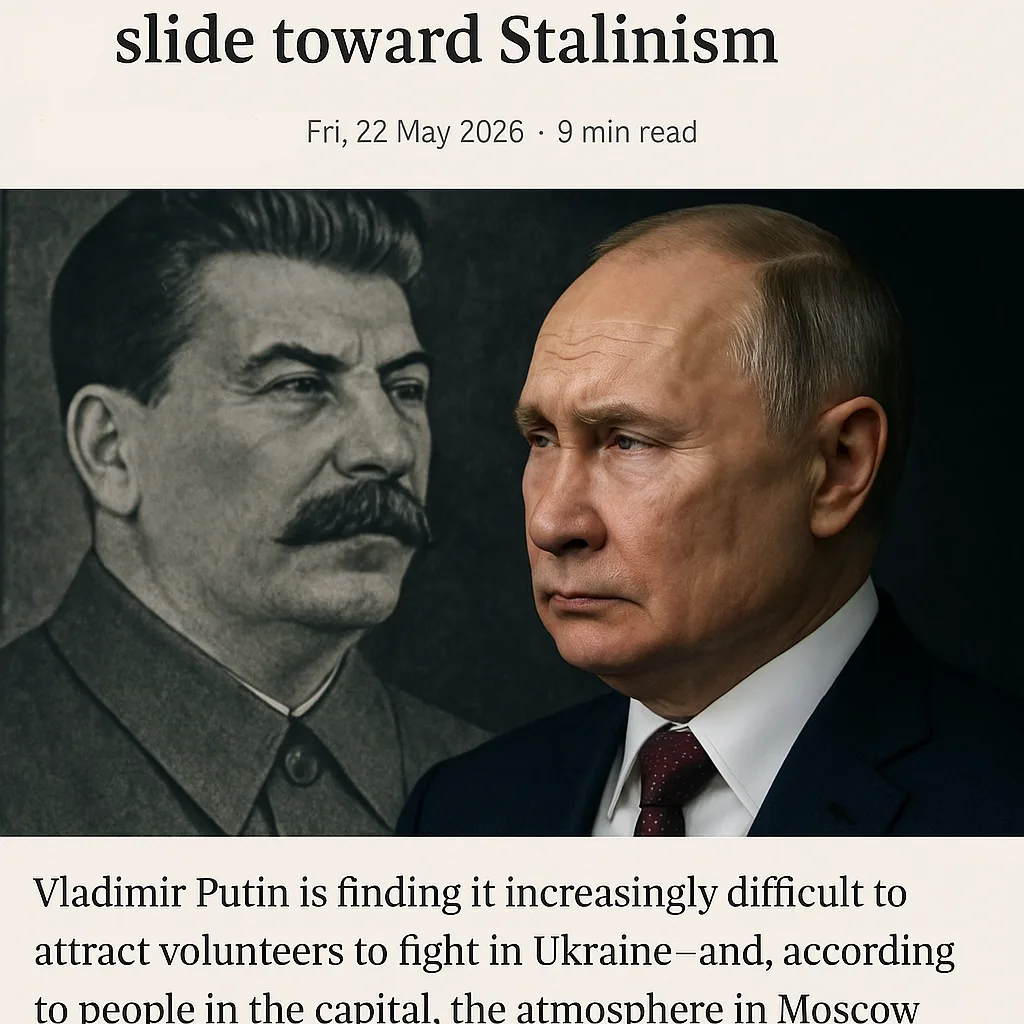
Putin’s moment of truth: end the war—or slide toward Stalinism
| Fri, 22 May 2026 | 9 min read
Vladimir Putin is finding it increasingly difficult to attract volunteers to fight in Ukraine—and, according to people in the capital, the atmosphere in Moscow has shifted.
For much of the past two years, especially after Ukraine’s counter-offensive stalled in August 2023, Moscow carried itself with confidence. Many residents either leaned into the patriotic narrative or simply tuned the war out, benefiting from an economy temporarily buoyed by wartime spending while the suffering stayed far away.
That sense of distance is fading. Across the political elite and in ordinary households, swagger has been replaced by unease. Fear and reflection are setting in, along with a growing desire for the conflict—rarely spoken about openly—to end.
The change is not hard to explain. The war has begun to feel close. Last weekend, Moscow and surrounding areas faced one of the heaviest drone assaults of the conflict, with hundreds launched toward the capital. Three people were killed, residential buildings were damaged, airports were shut down, and the city’s oil refinery was hit. For many Muscovites, the sound of drones and air defences offered an unwanted taste of what Ukrainians in Kyiv have lived with—and it rattled them.
A Moscow-based designer in her thirties, with two young children, told The Telegraph: “For the first time since the war began, I felt personally scared.”
But the deeper story is broader than a single night of attacks. Putin is confronting several problems at once: Ukraine is striking further inside Russia; Russian battlefield momentum has slowed and may be stalling; and economists warn that even higher oil prices and reduced sanctions pressure will not fix Russia’s weakening economic outlook. Revenues linked to the Iran war may steady state finances, but they are unlikely to restore growth.
Analysts argue this is pushing Putin toward a decision he has tried to avoid. Within the next year, he may have to either scale back the war—or abandon the implicit deal he has maintained with the Russian public by forcing far more people to fight.
“The Kremlin faces a fateful choice, probably within the next year,” said Nigel Gould-Davies of the International Institute of Strategic Studies (IISS). If Russia intends to keep the war going, he argues, it will need to extract resources “much more systematically and coercively,” returning to Soviet-style administrative controls.
According to an IISS paper published this week, that could mean moving toward a Stalinist-style economic model, with the entire economy subordinated to the state’s needs. In practice, Gould-Davies says, it would involve reversing some of the remaining post-Soviet freedoms: market and labour flexibility—and potentially even the ability to live and travel abroad.
Anxiety inside the system
Predictions of Russian collapse have circulated so often that many view them sceptically. Donald Trump, for example, has repeated claims that Ukraine lacks leverage, recently insisting that Volodymyr Zelensky “has even less” of a hand than before.
Yet a notable shift is that darker warnings are now coming from inside Russia. Last month, central bank governor Elvira Nabiullina described Russia’s labour shortage as the worst “in the history of modern Russia.” Even before 2022, Russia’s population was shrinking; since the invasion, hundreds of thousands have left the country, and at least a million more have reportedly been killed or wounded. Some estimates put the labour deficit above 2.5 million workers.
Official alarm is spreading. The economic development ministry has lowered growth forecasts, and even figures within the pro-Kremlin Communist Party have issued stark warnings. Party leader Gennady Zyuganov said last month that “the economy will inevitably fail,” invoking the spectre of a repeat of the 1917 revolution. Other Communist lawmakers have openly called for an end to the war.
Chris Weafer of Macro-Advisory notes how unusual it is to hear such blunt statements in public: senior figures are effectively acknowledging that prolonged sanctions and military spending are doing lasting damage—comments that would typically be censored.
A tired and angrier public
That official candour may reflect rising public frustration. Large-scale anti-war protests remain unlikely in a highly authoritarian state, but the Kremlin is aware that the “special military operation” commands less enthusiasm than it once did.
With drones reaching not only Moscow but cities far from Ukraine such as Yekaterinburg, more Russians are blaming Putin for bringing war closer to home. Anger is also growing over tighter internet controls, including restrictions affecting Telegram, one of the last major platforms still operating with some independence inside Russia.
Above all, the country is exhausted. Russia’s war in Ukraine has now lasted longer than its involvement in both World Wars. It is the longest major conflict in modern Russian history, and many Russians appear increasingly worn down by it.
“We are making history,” said one Moscow resident, “but it is a history we don’t want to make. People just want this to end.”
From wartime boom to stagnation
Economic pressure is central to the mood shift. In the early years of the war, heavy state spending on defence production and soldier pay helped fuel a consumer surge despite sanctions. Property demand rose, durable-goods purchases increased, and car loans more than doubled in 2024.
But the boom could not last. To curb inflation, the central bank raised rates to 21 per cent, and rapid growth has given way to stagnation.
Some hoped that the Iran war would change the picture. With fewer restrictions forcing Russia to sell oil at deep discounts, Moscow has exported as much as possible into an energy-hungry market, earning an estimated £40bn since US strikes on Iran began in February. That money may stabilise the budget and reduce the risk of a financial crisis—but Weafer argues it will not revive the broader economy.
“The war in the Gulf has bailed out the Russian budget,” he said. “But it doesn’t do anything for the economy… That is why officials are saying the conflict needs to end.”
Recent figures appear to support this: Russia’s economy contracted in the first quarter of the year for the first time since early 2023, and the economy ministry cut its 2026 growth forecast from 1.3 per cent to 0.4 per cent.
Outside defence, the outlook is worse. Analysts say much of the private sector has been hollowed out, and labour shortages have forced some factories onto four-day weeks. Timothy Ash of BlueBay describes Russia as a “two-speed economy”: the war machine functions, but much else is deteriorating, and after years of sanctions the system is hitting its limits.
Even defence production may be nearing capacity, with major firms operating around the clock. Shifting more civilian industry to military output risks worsening distortions in an economy already under strain. Labour shortages are so severe that Russia is trying to recruit workers from India and Africa, a move that could inflame anti-immigrant sentiment without solving the underlying problem.
A manpower crunch at the front
The most immediate danger for the Kremlin may be personnel. For the first time since late 2022, Russian losses on the battlefield reportedly exceed recruitment. Some estimates put casualties at around 35,000 a month, while volunteer numbers may be closer to 24,000–30,000.
That leaves Putin facing a pivotal choice. Russia is attempting something unusual in its history: fighting a major war without full-scale mobilisation. Gould-Davies says Russia has built a “war economy, but not a war society,” protecting most citizens from direct sacrifice while paying volunteers to serve.
But paying rather than compelling people to fight may no longer be enough. If Putin insists on continuing, broader conscription could become unavoidable.
A reminder of the political risk came in September 2022, when Putin announced a partial mobilisation of 300,000 men after battlefield setbacks—prompting hundreds of thousands to flee the country.
A much larger call-up could change the military balance, particularly given Ukraine’s own recruitment challenges and smaller population. Yet it would likely require the Kremlin to clamp down on freedoms gained after the Soviet collapse: the ability to move abroad, own property freely, and choose employment. Preventing men of fighting age from leaving would become essential. And sustaining a greatly expanded war effort could mean placing private industry under direct state control—an approach increasingly promoted by hardliners.
“Since 2023, some prominent public figures have begun to extol not only the Soviet but specifically the Stalinist economy,” Gould-Davies says—arguing that these are precisely the steps the state would need to fully organise society for prolonged war.
For three years, Putin has asked Russians to accept the war while insulating most of them from its costs. That bargain is weakening. The Kremlin may find it can no longer fight abroad without pulling Russia back toward the coercive, tightly controlled authoritarianism of its Soviet past.
Sources
(no citations in this draft)
Leave a Reply
You must be logged in to post a comment.