
2 sources of similar editorial. May reflect a single perspective.
See the sources
- Sky News · neutral
- bsky.app/profile/cnn.com · neutral
AumaScout shows how widely a story is reported across independent sources — not whether it is true. Always check the originals.
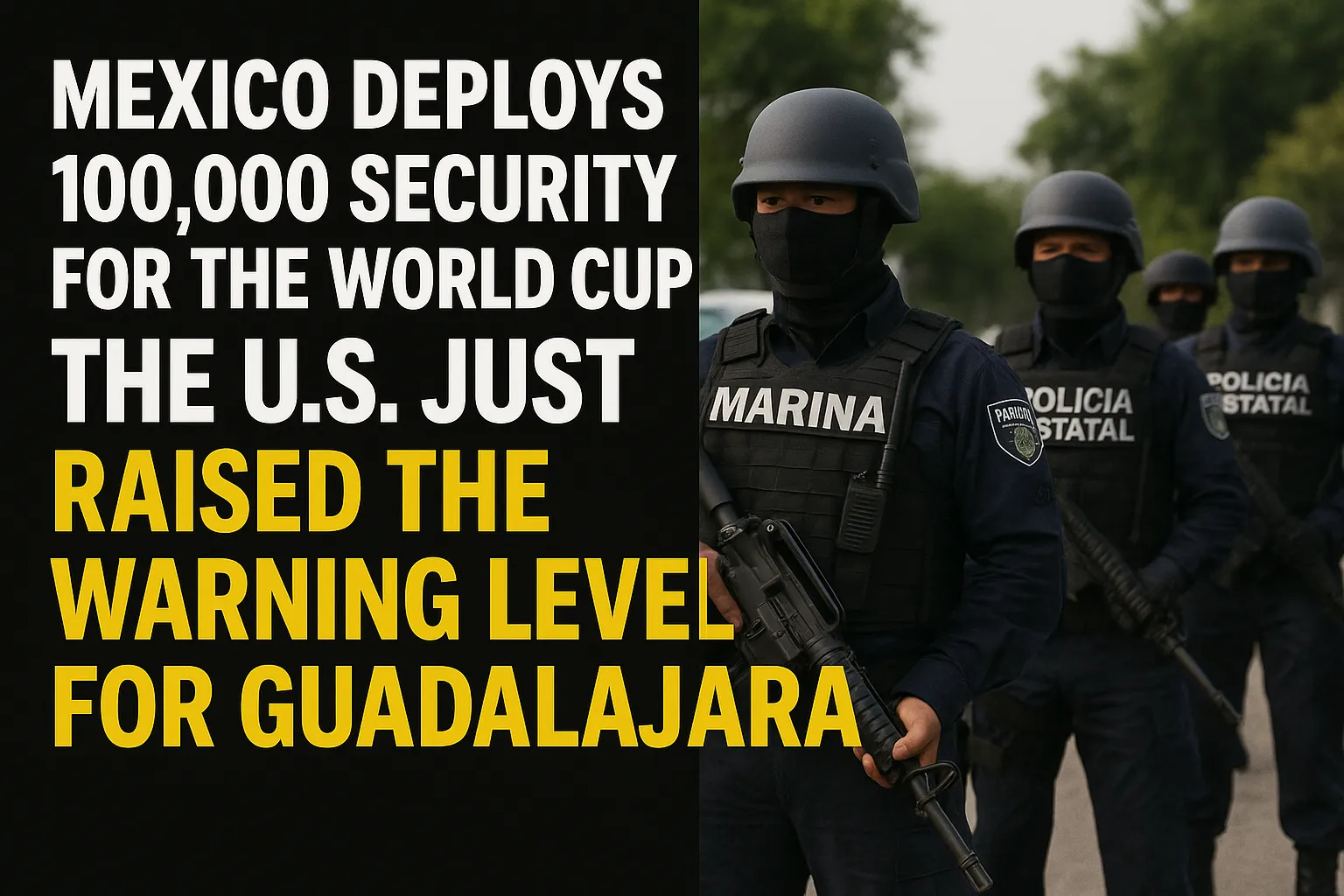
Mexico's federal government is deploying as many as 100,000 security personnel across the three host cities of the 2026 FIFA World Cup, while the U.S. State Department maintains a sharper travel warning for one of them — Guadalajara — than for the other two.
The deployment, announced by President Claudia [1] , comprises roughly 20,000 military personnel, 55,000 police officers, and additional staff from private security firms. It forms part of an inter-agency strategy reported as Plan Kukulkan — named for the serpent deity from Maya mythology — that coordinates federal, state and local agencies across host venues, training centres and fan zones.
What the U.S. warning actually says
In a refresh issued Friday, 29 May, the State Department keeps Mexico overall at Level 2 — "Exercise Increased Caution", the same level applied to Spain, France and Sweden. But the picture breaks down differently by host city:
- Mexico City — Level 2
- Monterrey (Nuevo León) — Level 2
- Guadalajara (Jalisco) — Level 3 — "Reconsider Travel"
The advisory's specific language for Jalisco notes that "in Guadalajara, battles between criminal groups have happened in tourist areas." Risks cited across the country include homicide, kidnapping, carjacking, sexual assault, armed robbery, and terrorist violence. The State Department also flags armed robberies on highways 85/85D, 54 and 40/40D near Monterrey — a specific call-out for fans planning to drive between matches.
What the risk looks like up close
Outside the cartel-driven concerns there is the everyday risk picture every major football tournament brings: pickpocketing, snatch-and-grab theft on public transit, and "express kidnappings" via unlicensed taxis. Travel-safety publishers and risk-consultancy firms reporting on the tournament have converged on the same practical guidance for spectators:
- Use authorised taxi kiosks or ride-sharing apps; never hail taxis on the street
- Travel between fan zones and stadiums via expanded metro and light-rail
- Know your exits at fan festivals and avoid carrying valuables in crowds
- Stay out of protests and avoid isolated areas, especially at night
Separately, Crisis24 and other risk analysts highlight environmental and health risks: extreme summer heat, food and waterborne illness, and the advisability of being up to date on routine vaccinations before travel.
The bigger picture
For most fans, most of the time, Mexico's three host cities will be heavily policed and visibly secured during match days. The country is no stranger to hosting global sport — Mexico hosted the World Cup in 1970 and 1986 — and the public-facing security envelope around tournaments is generally robust.
But the U.S. State Department's decision to keep Jalisco at "Reconsider Travel" — a higher tier than Mexico City or Monterrey — is unusual for a host state and worth attending to if your itinerary includes Guadalajara matches.
[2]
Sources
[1] bsky.app/profile/cnn.com (T3, neutral) — "Iran's national soccer team will sleep in Mexico and travel to the United States on the days of its three World Cup matches after Washington" — 2026-05-26
🔗 bsky.app/profile/cnn.com/…
Score: ★★★ Corroborated. Cited from AumaScout corpus.
[2] Sky News (T3, neutral) — "The missing persons crisis threatening to overshadow Mexico's World Cup" — 2026-05-26
🔗 bsky.app/profile/news.sky.com/…
Score: ★★★ Corroborated. Cited from AumaScout corpus.
Leave a Reply
You must be logged in to post a comment.