
Fri, 22 May 2026, 11:53 pm (GMT+7) • 6 min read
On Wednesday morning, Vilnius feared it was under attack.
Lithuania’s president and prime minister were rushed into a blast-resistant bunker as flights were halted, traffic froze and thousands of residents took shelter in underground car parks.
It was the first evacuation order issued in a Nato capital since Russia’s full-scale invasion of Ukraine in 2022 — and it came around 1,000 miles from the front line. At the time, no one could say where the drones overhead had come from.
The alarm was the latest in a growing series of incidents along Nato’s eastern border, pulling the war in Ukraine uncomfortably close.
But the aircraft crossing Lithuania, Estonia, Latvia and Finland were not launched by Russia directly. Instead, they were Ukrainian drones that Russia had seized control of mid-flight and diverted into Nato airspace — a sign that the conflict is entering a new phase.
“There is no reason for Russia to stop, because there will be no costs or consequences imposed on Moscow, and the return on the effort they are putting in is enormous,” said Keir Giles, an associate fellow at Chatham House and author of Who Will Defend Europe.
“The fact that GPS has been interdicted over a wide area of the Baltic Sea and beyond ought to have been a much bigger scandal than it ever was.”
The tactic threatens one of Ukraine’s most effective tools: low-cost drones that can be built for a few thousand pounds and have helped take the fight deep into Russia.
Flying low to avoid radar and cheap enough to send in large numbers, Ukrainian drones have reached Moscow, struck Baltic Sea oil terminals, ignited fuel depots and disabled radar sites more than 1,000 miles from Ukraine in a sustained pressure campaign.
Russia, however, has found a way to turn these drones to its advantage — not by shooting them down, but by convincing them they are somewhere else.
Since March, drones thrown off course by Russian electronic warfare have crashed in Estonia, detonated at an oil storage facility in Latvia, and forced a Nato F-16 to shoot down a drone over Estonian territory — a first for the alliance.
In Latvia, the political fallout has been severe. The prime minister resigned this week, after a coalition partner withdrew support over her handling of an earlier drone incursion and her decision to dismiss the defence minister, Andris Sprūds.
This spread of chaos across the Baltic states and Finland exploits a weakness that has existed since GPS was created — and one Russia has spent years learning to manipulate.
Since the invasion of Ukraine, electronic warfare has shifted from a specialised battlefield capability to something closer to mass deployment.
The method relies on a one-two punch: jamming and spoofing.
First, a drone’s GPS receiver is overwhelmed with high-powered radio noise, cutting it off from real satellite signals — “jamming”. Once the receiver loses its fix and starts searching for a signal to lock onto, Russia transmits a counterfeit navigation signal that is stronger than anything else nearby. The receiver accepts it as genuine — “spoofing” — and the drone begins flying on false instructions.
“Everyone is listening to the signals from the satellites out in space… and unfortunately, we, the public, all use unencrypted open signals,” said Ramsey Faragher, chief executive of the Royal Institute of Navigation.
“That means it’s very easy to decode them and use them, but it’s also very easy to write software that can broadcast perfectly good-looking fake versions of those signals.”
Using live data from Estonia’s border region, Faragher says the spoofing is visible in real time.
Ukrainian drones are made to “believe” they are far deeper inside Russia than they really are — prompting them to steer away, drifting west into Nato airspace.
Russia also manipulates time data, pushing navigation systems years — sometimes decades — forward or backward.
“If you can make computers think they’re in completely the wrong decade, you can often cause them to hang, reboot, or completely fail,” Faragher said.
“It’s what’s often called bricking… They’re trying to literally crash the drones… by feeding such an incorrect time into the computer that the software faults and falls over.”
This isn’t ad-hoc disruption. It’s a long-term, permanent electronic-warfare architecture.
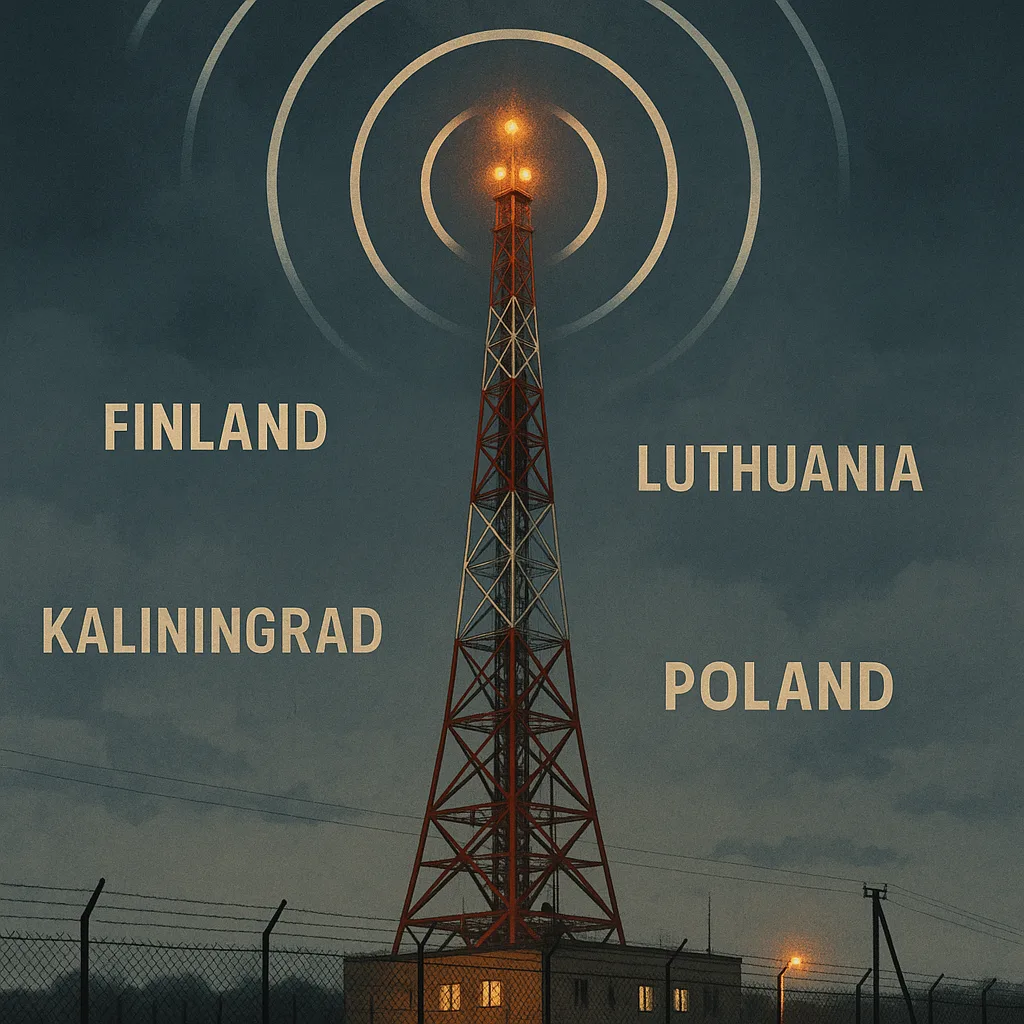
At the centre is a powerful transmitter in Kaliningrad — Russia’s western enclave between Poland and Lithuania — which has run for years and can knock out GPS across hundreds of miles of Baltic airspace. The interference is now so strong that Finland’s emergency services can no longer rely on GPS alone.
Faragher also points to evidence Russia has tested satellites capable of jamming and spoofing from orbit.
Ukraine is adapting. Fibre-optic drones — guided through a cable that unspools behind them — cannot be jammed and can now strike targets up to 12 miles away.
It is also fielding AI-guided drones that navigate using cameras and terrain matching rather than GPS, hitting targets hundreds of miles away without emitting signals Russia can disrupt.
But Russia is adapting too.
The signals being broadcast have grown more sophisticated, leaving fewer navigation bands untouched — and Moscow has begun deploying its own fibre-optic drones in response.
“Basically, everything is getting jammed and spoofed now,” Faragher said. “Everything.”
He argues the long-term defence lies in smarter antennas — controlled radiation pattern antennas — designed to reject counterfeit signals and lock onto authentic ones. They remain expensive, but could become widespread as prices fall.
Some experts say the tactic may amount to an act of aggression against Nato.
“Russia is actively violating Nato and European airspace,” said Spencer Faragasso, a senior research fellow at the Institute for Science and International Security.
He said the incidents fit into a broader “shadow war” Russia has waged against Europe for years — not only disrupting navigation, but deliberately provoking political crises inside Nato states.
The goal, he argues, is to test the alliance’s resolve without crossing the clear legal threshold of a direct attack.
“Right now, Europe is being tested by Russia to gauge its level of response, unity, readiness, and capabilities,” Faragasso said.
“Given Russia’s clear antagonism towards Europe, over time, this threat is more likely to increase, not decrease.”
Sources
(no citations in this draft)
Leave a Reply
You must be logged in to post a comment.